


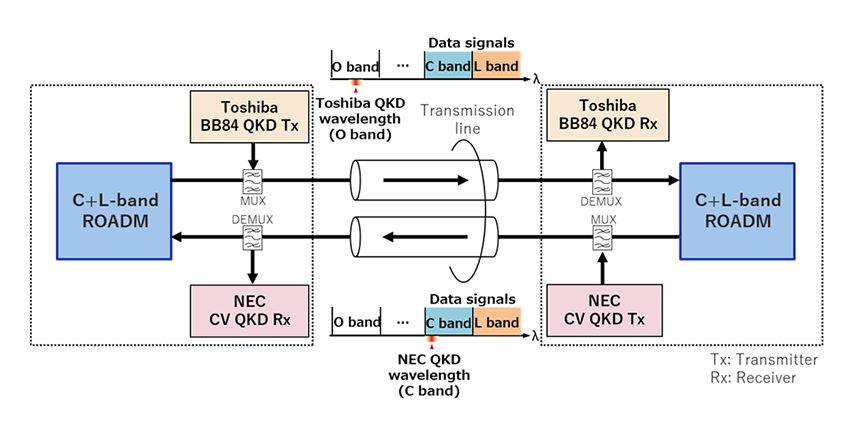
Toshiba, NEC, and Japan’s National Institute of Information and Communications Technology (NICT) have demonstrated the world’s first multiplexed transmission of quantum key distribution (QKD) signals within an IOWN all-photonics network (APN) environment. The trial, conducted at NICT’s Quantum ICT Collaboration Center, integrated high-capacity optical data signals with two different QKD protocols—Toshiba’s BB84 and NEC’s continuous-variable (CV)—over the same transmission section of a telecom-grade optical backbone.
Using NEC’s SpectralWave WX Series ROADM system across the C+L bands, the team successfully multiplexed 47.2 Tbps dummy data with QKD signals over 25 km of fiber, maintaining error-free transmission at 400 Gbps and 800 Gbps per wavelength, while simultaneously generating encryption keys continuously for eight hours.
This breakthrough eliminates the need for costly dedicated “dark fiber” for QKD, showing that quantum-secure communications can coexist with commercial telecom networks. It supports deployment of scalable, low-cost, and highly reliable QKD networks for applications such as finance, government, and cloud services. The demonstration also aligns with the IOWN Global Forum’s “One-span PtP Wavelength Path” use case, advancing the realization of secure, wide-area quantum cryptographic communication infrastructure. Toshiba, NEC, and NICT will continue joint R&D to accelerate practical adoption.












Leave a comment